
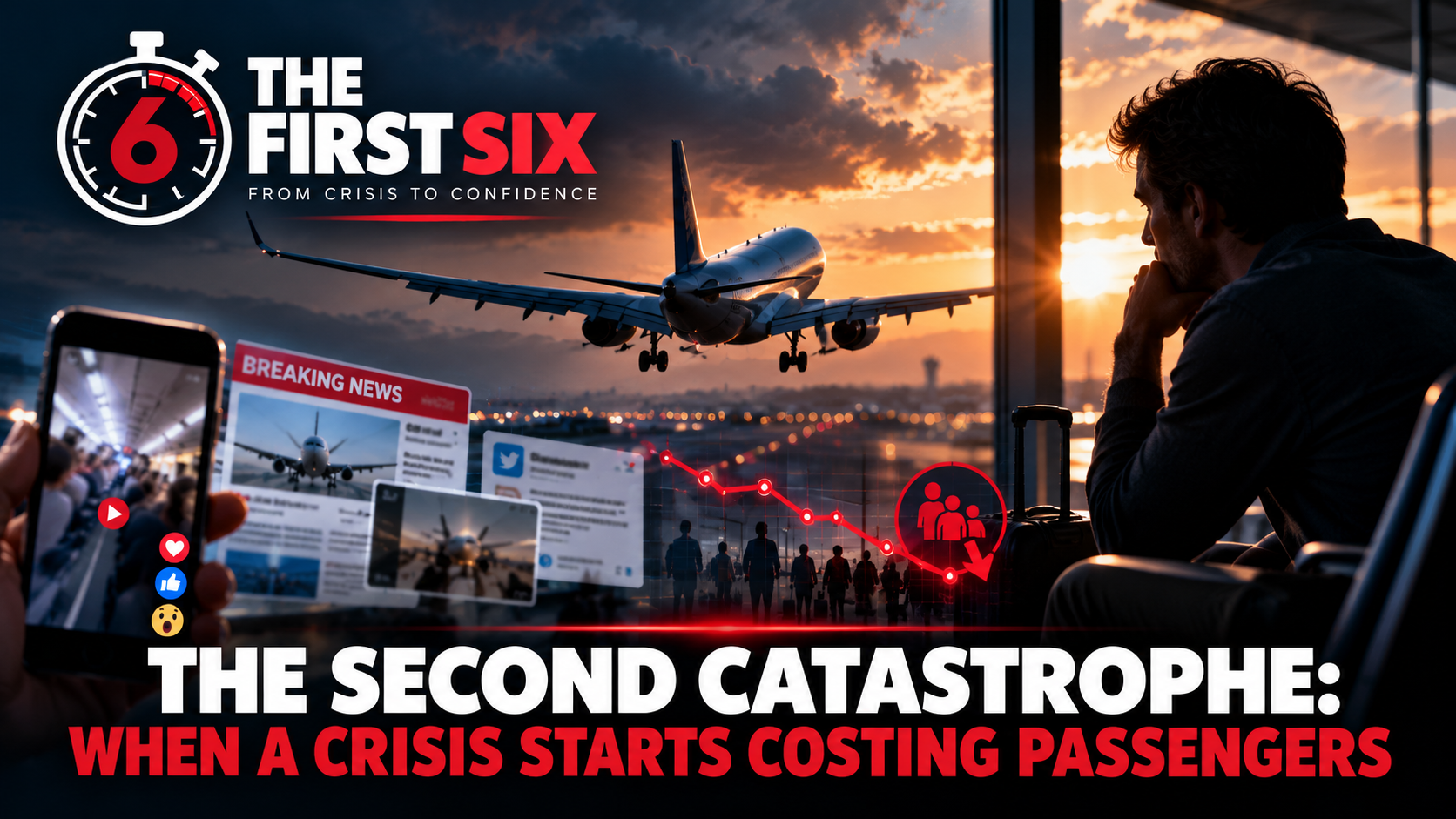
The flydubai incident highlights the importance of crisis preparedness beyond the cockpit. With THE FIRST SIX, Sven Klawunder from Flying Media and Prof. Dr. Wolfgang Georg Arlt (The meaningful Tourism Centre) are developing a new training and implementation concept to help airlines, destinations and tourism organisations prepare for the communication challenges of a crisis.
Beyond the emergency landing: The communication challenge begins
Aviation is built around safety procedures, operational discipline and clearly defined responsibilities. Yet even when an immediate emergency has been brought under control, another demanding phase begins: communicating with passengers, employees, the media and the wider public.
The incident involving flydubai flight FZ1073 on 30 September 2026 provides a timely reminder of these challenges. The Boeing 737 MAX 8 was operating from Dubai to Tel Aviv when a security incident occurred on board. The aircraft diverted to Tabuk, Saudi Arabia, where it landed safely. According to the United Arab Emirates General Civil Aviation Authority, members of the crew sustained injuries and were taken to hospital. Investigations into the circumstances of the incident are ongoing.
While the relevant authorities establish what happened and why, the incident illustrates a broader issue facing the aviation industry: how an airline communicates when an extraordinary event attracts immediate international attention.
In today’s connected media environment, an aviation incident can become a global news story within minutes. Passengers share their experiences, eyewitness accounts circulate online and news organisations seek immediate explanations. Information may emerge from multiple sources before a complete, verified picture is available.
For an airline, this creates a second operational challenge. Alongside the immediate response, it must provide reliable information, coordinate its communication and address the concerns of passengers and their families.
The objective is not to control the story. It is to ensure that accurate information reaches the people who need it.
The second catastrophe: When confidence begins to erode
A crisis does not end when an aircraft reaches the ground safely. Depending on the circumstances, the communication challenges may continue for days, weeks or even months.
Passengers want to know what happened, whether they are safe, what happens next and whether they can continue to trust the airline. Employees need consistent information. Business partners, regulators and airport operators may require updates, while journalists need verified facts and access to appropriate spokespersons.
When communication is delayed, contradictory or difficult to understand, unanswered questions can be filled by speculation. Inaccurate information may spread faster than official updates, particularly when dramatic images or unverified eyewitness accounts circulate on social media.
The consequences can extend beyond the immediate incident. Customer confidence, future bookings, commercial relationships and corporate reputation may all be affected.
This is the second catastrophe: not another physical event, but the potential loss of confidence that follows a crisis when communication fails to meet the needs of those affected.
That does not mean that every crisis will damage an airline’s reputation or that communications alone can determine the outcome. The quality of the operational response, the facts of the incident, the treatment of passengers and the subsequent investigation all matter. Communication is one essential element of a much larger response.
Why preparation must begin before the crisis
In aviation, emergency procedures are not developed after an incident occurs. They are prepared, tested and refined in advance.
Crisis communication requires the same discipline.
Organisations need to know who is authorised to speak, how information is verified, which departments must be involved and how updates reach different audiences. They must also understand how to communicate uncertainty without creating confusion or making premature claims.
A practical crisis communication framework should address several core questions:
- Who takes responsibility? Clear roles and decision-making authority are essential when several departments and external organisations are involved.
- What is known? Verified facts must be separated from assumptions, eyewitness accounts and information that remains under investigation.
- Who needs to know? Passengers, families, employees, regulators, airport partners and media organisations have different information needs.
- Who communicates? A designated spokesperson and coordinated communication channels help reduce contradictions.
- How does the organisation respond to misinformation? Teams need procedures for monitoring emerging narratives, correcting demonstrably false information and providing updates.
- What happens after the immediate emergency? Communication must continue through operational recovery, the investigation and the process of rebuilding confidence.
These questions cannot be answered effectively for the first time in the middle of a crisis. They require preparation, training and realistic exercises.
Introducing THE FIRST SIX: Preparing for the critical hours
This is the context in which THE FIRST SIX is being developed by Sven Klaunder, Flying Media and Prof. Dr. Wolfgang Georg Arlt (Meaningful Tourism Centre).
The initiative focuses on crisis communication in tourism and aviation, with the aim of helping organisations establish practical structures before an emergency occurs.
The concept is designed for airlines, airports, tourism authorities, destinations and other organisations whose operations and reputation may be affected by a crisis. Its approach combines communication expertise, international media experience, structured preparation and practical training.
The programme is being developed in several formats, ranging from keynote presentations and focused workshops to more intensive implementation labs.
The central idea is straightforward: the first six hours of a crisis should not be spent deciding how an organisation is going to communicate. The essential responsibilities, procedures and communication channels should already be established.
THE FIRST SIX is intended to help organisations translate that principle into practical preparation.
A workshop can examine how a crisis develops, how responsibilities are assigned, how verified information is collected and how a communication team responds to rapidly changing circumstances. Simulations can introduce difficult media questions, conflicting reports and the pressure of communicating while important facts remain unknown.
An implementation lab can take the process further by helping participants develop and test procedures relevant to their own organisation.
The programme is not a replacement for aviation safety management, emergency response procedures or official investigations. Instead, it addresses the communication structures that must work alongside those systems.

From the first statement to the long-term recovery
A central challenge in aviation crisis communication is finding the right balance between speed and accuracy.
An organisation that waits until every detail is known may leave passengers and the public without essential information. An organisation that communicates unverified claims risks having to correct its own statements later.
The practical answer is a structured approach to successive updates.
An initial statement should confirm the information that can responsibly be disclosed, explain what is being done and indicate when further information may be available. Subsequent updates should distinguish confirmed developments from open questions and respect the responsibilities of investigators and relevant authorities.
The same discipline must apply across communication channels. Statements to the media, passenger notifications, internal employee communications and social media updates should be coordinated without ignoring the different needs of their audiences.
Artificial intelligence adds another dimension. Digital tools can support information monitoring, analysis and the identification of emerging narratives. At the same time, AI-generated images, synthetic audio and misleading summaries can complicate the verification process. Crisis teams therefore need clear procedures for checking sources and authenticating material before publishing or repeating it.
These challenges are relevant not only to airlines. Airports, tourism boards, destination management organisations and hospitality businesses can also find themselves responding to an incident whose consequences extend far beyond their immediate operations.
Aviation and tourism are interconnected. A serious incident can affect connecting travel, destination perceptions, travel planning and the confidence of international visitors. Communication therefore needs to consider the wider network of stakeholders involved.
Protecting people, facts and trust
The development of THE FIRST SIX reflects a broader recognition that crisis preparedness must include more than operational contingency plans.
The initiative brings together Flying Media’s experience in international media and communication with the expertise of Prof. Dr. Wolfgang Georg Arlt in tourism and the Meaningful Tourism approach. Its focus is on helping organisations prepare for difficult situations through clear responsibilities, practical procedures and realistic training.
For airlines, this means considering not only how an emergency response is activated, but also how passengers receive information, how employees are briefed, how media enquiries are handled and how communication continues once the aircraft has landed.
The flydubai incident is a current example of why these questions matter. The investigation must establish the facts, and conclusions about the causes or circumstances should not precede its findings. Nevertheless, the communication challenges associated with an event of this nature are already relevant to the wider industry.
Preparedness cannot eliminate every crisis. Nor can communication reverse the consequences of an incident. What organisations can do is establish systems that enable them to respond with greater clarity, consistency and responsibility when pressure is at its highest.
For THE FIRST SIX, the guiding principle is to prepare before a crisis, communicate with verified facts during it and maintain the commitment to transparency throughout the recovery.
Because the first six hours matter. But so does every message that follows.